History
The Hallstatt Culture: How a Salt Village Named Europe's Iron Age
The Hallstatt culture is the name archaeologists give to the earlier part of the Iron Age in central Europe, a period the Natural History Museum Vienna (NHM) dates to around 800 to 400 BC. It is named after the village because of what lies above it: a prehistoric cemetery in the high valley behind Hallstatt, discovered in 1846 by the manager of the salt mine, Johann Georg Ramsauer. The graves held such rich and far-travelled objects, and Ramsauer recorded them so carefully, that the find-spot gave its name to a whole epoch of European history.
The wealth behind those graves came from salt. The NHM says people have been mining salt in this valley for 7,000 years, and the community buried in the high valley grew prosperous by digging it out of the mountain and trading it across Europe. This article explains what the Hallstatt culture was, what the cemetery and the mine have revealed, how it relates to the Celts, and where you can see the finds today, in the village and in Vienna.
The short answer
- What it is: the name for the earlier Iron Age in central Europe, taken from the cemetery in the Hallstatt high valley.
- When: around 800 to 400 BC in the NHM’s dating. Some reference works, such as Britannica, start the sequence earlier, in the late Bronze Age.
- Why Hallstatt: salt. Mining here is among the oldest anywhere, and it paid for graves filled with goods from across Europe.
- Who found it: Johann Georg Ramsauer, manager of the salt mine, from 1846. He dug around 1,000 graves before he stopped in 1863.
- How big: more than 1,500 graves have been documented, and the latest research suggests between 5,000 and 6,000 people were buried there.
- Where to see it: the Hallstatt World Heritage Museum in the village, the burial ground in the high valley above it, and Hall 12 of the Natural History Museum in Vienna.
How a village gave its name to an era
Archaeologists usually name a prehistoric culture after the place where it was first defined. Around the middle of the nineteenth century Ramsauer, the mine master in charge of the salt works, realised that the many prehistoric objects turning up above ground were the remains of a cemetery. He began to excavate it in 1846 and continued systematically until 1863.
The NHM credits two things for the name. The first is the scale of what he found: around 1,000 graves with copious burial objects, most of which ended up in Vienna. The second is how he recorded them. Ramsauer left detailed protocols, grave descriptions, maps and watercolour plates of the graves and their contents, and the museum says it was thanks to this meticulous work that the site became eponymous for an entire epoch of European cultural history.
Interest in Hallstatt’s past did not begin with him: in 1607, finds from Hallstatt were already listed in the art collection of Emperor Rudolph II. Ramsauer sent his first finds to Vienna in 1850, and the NHM has excavated in the mines every year since 1960 and at the burial site since 1992.
Salt before iron: the Bronze Age mine
The cemetery is the famous part, but the mine is older. The NHM describes the high valley as occupied more or less continuously since the start of the Neolithic, some 7,000 years ago. An antler pick used about 5000 BC may point to early mining, although the museum notes it could equally have been used to open up a salt spring.
Systematic mining began in the Middle Bronze Age. The NHM dates the earliest mining activity to around 1500 BC, which it says makes Hallstatt’s salt mines the oldest in the world, and, on another of its pages, describes salt mining as a flourishing industry by around 1550 BC. UNESCO’s description of the World Heritage site gives the same broad picture, with systematic salt production in the region as early as the Middle Bronze Age.
The Bronze Age miners left behind things that almost never survive elsewhere:
- A wooden staircase. The oldest wooden stairs ever found in Europe come from a Bronze Age gallery, built with treads that could be adjusted to the slope.
- Carrying sacks. Their design let a miner empty a full load with a single movement of the hand.
- Clothing. Caps of hide and fur, and scraps of wool, flax and hemp.
- A meat industry. Tubs for curing meat, carbon-dated to the thirteenth and twelfth centuries BC, each held between 150 and 200 animals, mostly pigs.
The NHM’s pages are not perfectly consistent on how this phase ended: one says Bronze Age mining stopped around 1245 BC, when a debris flow buried the workings, while the curing tubs are dated into the twelfth century BC.
The Hallstatt period, 800 to 400 BC
After a gap of around 300 years with no evidence of mining, work resumed in a different part of the mountain, using new methods. Bronze Age miners had smashed the rock into small pieces; Hallstatt-period miners cut the salt out as bars, carving heart-shaped grooves into the rock face. UNESCO places the restart of underground mining in the eighth century BC.
This is the period that carries the village’s name. The NHM describes the earlier Iron Age as a time of upheaval across Europe: the adoption of iron from the ninth century BC brought a concentration of economic and political power and a sharper social hierarchy, with new ideas arriving from the south and east. UNESCO describes the community at Hallstatt as a flourishing, stratified and highly organised Iron Age society with wide trade links across Europe.
Daily life underground was hard:
- Food. Analysis of remains found in the mine shows the miners lived largely on Ritschert, a thick porridge of barley, millet and broad beans with low-quality meat. A dish of the same name is still served in the Eastern Alps.
- Children. Skeletons from the cemetery show signs of heavy physical work in children aged eight and older, and the NHM thinks children carried salt and rock from about the age of five.
Oddly, no settlement from the Hallstatt period has yet been found. The NHM believes a large settlement in the Salzbergtal, almost certainly the one connected with the cemetery, was buried by a major landslide around 350 BC.
The cemetery in the high valley
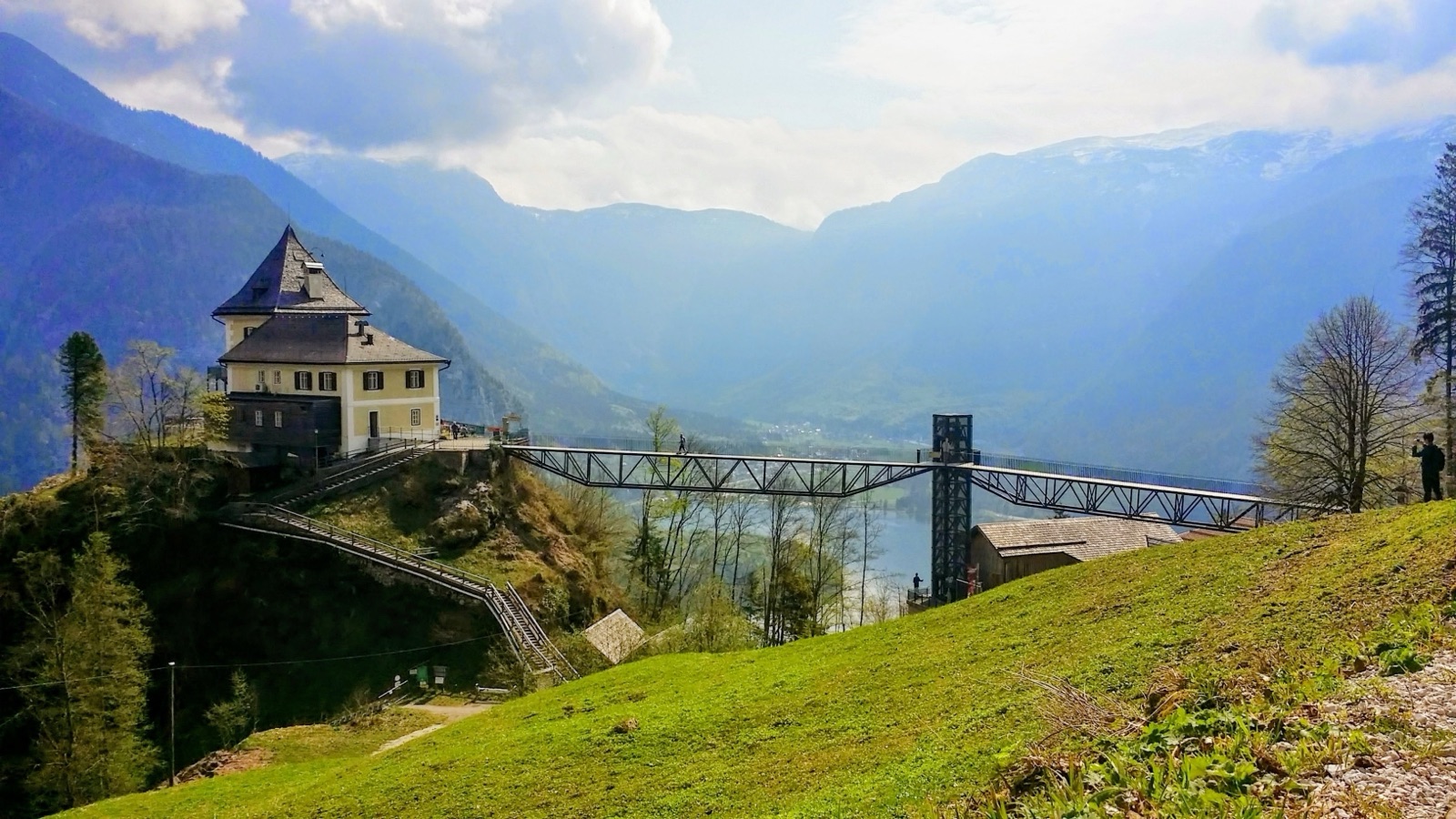
The burial ground lies in the high valley above the village. Its size and the range of goods in it make it, in the NHM’s words, one of the most important archaeological sites in the world, and the objects came from almost every region known to its people at the time, evidence that salt bought far-reaching contacts.
What the numbers say:
- Ramsauer excavated around 1,000 graves between 1846 and 1863.
- The NHM gives around 1,500 graves excavated to date, most of them in the nineteenth and early twentieth centuries.
- The graves date from between 800 and about 350 BC.
- The latest research suggests between 5,000 and 6,000 people were buried there, so most graves have never been opened.
Britannica gives a higher count of more than 2,000 graves found between 1846 and 1899. The sources count differently, and we have followed the NHM, which carries out the excavations.
Excavations since the 1990s show that the people buried with these valuable gifts did very strenuous physical work: this was a cemetery of miners, not only of a distant elite.
The digging is not finished. In 2023, while a rockfall barrier was being built across the burial ground, NHM archaeologists found an undisturbed cremation grave with bronze gifts. Imprints of fabric on the metal may be the first evidence that the ashes were buried in an organic container, such as a cloth or leather pouch, a practice the excavators had long suspected.
Phases A to D: how archaeologists divide it
Reference books can seem to disagree about when the Hallstatt culture began. The reason is that two schemes are in use.
Britannica describes the Hallstatt sequence in four phases, A to D, while noting that scholars disagree about how to date them:
- Phase A, when iron was still rare and the dead were cremated.
- Phase B, confined to the western regions, when burial mounds became common again.
- Phase C, when iron came into general use, with long iron and bronze swords and the winged Hallstatt axe.
- Phase D, which lasted until the La Tène period took over in other areas.
Britannica also sorts most of the Hallstatt graves into an earlier group (c. 1100/1000 to c. 800/700 BCE) and a later one (c. 800/700 to 450 BCE). That is why some books start the Hallstatt culture in the late Bronze Age, while the NHM uses the term for the Iron Age from around 800 BC.
Whichever scheme you follow, the art is recognisable: Britannica calls it severely geometric, with a typical bird motif probably derived from Italy.
Were the people of Hallstatt Celts?
This is the question visitors ask most, and the answer depends on what you mean by Celts. Britannica says the oldest archaeological evidence of the Celts comes from Hallstatt: excavated chieftains’ graves there, from about 700 BCE, show one of the first Iron Age cultures in Europe, which received luxury goods such as bronze and pottery vessels through Greek trade. By the mid-fifth century BCE, it says, the La Tène culture had begun to emerge among the Celts of the middle Rhine, and La Tène art is what most people now picture as Celtic.
The NHM’s pages, by contrast, describe the people of the high valley as miners and traders, and call them illiterate. They left no writing, so the finds cannot tell us what language anyone spoke or what they called themselves. Hallstatt is best described as an early Iron Age culture that Britannica places at the start of the Celtic story, rather than as proof that its miners thought of themselves as Celts.
What the salt preserved
Salt is the reason Hallstatt’s finds are so unusual. Under normal conditions wood, cloth, leather and food rot away within years. In the mine, the NHM says, organic material has been preserved from decay for up to 3,500 years: wood, fur, grass, food remains, even faeces. Britannica adds that implements, parts of clothing and even the bodies of miners have been recovered.
Textiles are a particular strength. Burial customs changed during the Hallstatt period and fewer organic remains survive from it elsewhere in Europe, so the scraps of cloth thrown into the mine after their useful life are some of the best evidence anywhere for what people of the time wore.
Salt also preserved people. In 1734, miners working in a gallery called the Kilbwerk found the body of a prehistoric miner, mummified by salt, with traces of his clothes and shoes. They guessed he was more than 400 years old. Modern research places him in the Early La Tène period: he probably died around 350 BC in the same natural disaster that devastated the valley. He was reburied in the village graveyard, so he is lost to science, and the NHM says the hope of finding another salt mummy is still a strong incentive for research.
After the catastrophe: La Tène miners and Romans
The disaster of around 350 BC did not end mining. In the La Tène period, which the NHM dates from around 400 BC until 30 AD, miners worked from the Dammwiese, a moorland meadow 1,357 metres above sea level, probably to escape the landslides lower down. Their mine, known as the Western Group, covered a surface of 72,000 square metres and reached a depth of 330 metres, making it the largest of the prehistoric mines. A timbered adit entrance with its entrance building was discovered there in 1937.
The Romans came next, but not to the mine. They built a large settlement by the lake, in what is now the Lahn district, with solid stone houses, floor heating through brick channels some 70 cm wide, and brightly painted plaster walls. There is no evidence of Roman mining, and the NHM thinks they were content to control the salt trade.
In 1983 a rescue dig 250 metres west of the houses recovered seven cremation graves. Inscriptions scratched on the pots named the dead, a sign that reading and writing had reached this remote valley and that Celtic names had quickly given way to Latin ones. Roman military bases and civil administration were withdrawn from the region in 488 AD.
From medieval salt to the Bone House
The NHM has found no evidence that the salt was used between the fifth and the thirteenth centuries. Mining revived in the Middle Ages, and around 1311 Queen Elisabeth put salt mining and brine boiling under state control, where they stayed until 1998; on 21 January of that same year, 1311, she also granted the citizens of Hallstatt market rights.
Two later events shaped the village you see today:
- The fire. On 20 September 1750 a blaze swept through the market town, destroying all the state buildings and nine salt producers’ houses and killing four people. UNESCO notes that Hallstatt was rebuilt in late Baroque style after the fire.
- The first visitors underground. In 1926, when the salt industry was in crisis, part of the mine opened to visitors as a tourist mine. It drew 6,630 visitors in its first year.
The village also has its own, much later relationship with the dead. Its churchyard is too small to expand and cremation was long forbidden, so graves were reopened 10 to 15 years after a burial and the bones moved to the ossuary, the Bone House, in St Michael’s Chapel. It holds 1,200 skulls, 610 of them painted with names, dates and wreaths, a custom that began in 1720. The youngest skull arrived in 1995. Our guide to Hallstatt and the Dachstein covers visiting it.
Where to see the finds
In Hallstatt: the World Heritage Museum. The museum at Seestraße 56, in the centre of the village, shows original finds from the burial ground alongside displays on religion, everyday life and tourism. The tourist board lists it as open daily, from 10:00 to 18:00 between May and September and with shorter hours the rest of the year; adult entry is €12. Check before you go.
In the high valley: the burial ground. The funicular to the salt mine climbs to the valley where the cemetery lies, and the mine operator’s route includes a walk-through burial chamber about the prehistoric settlers. Our salt mine and Skywalk guide has the tickets, hours and the tour itself.
In Vienna: the Natural History Museum. Most of Ramsauer’s finds went to Vienna. At the NHM, Hall 12 is entirely dedicated to the prehistoric salt mine and settlement of Hallstatt. It shows Bronze Age carrying sacks, the oldest surviving wooden staircase in Europe, textiles and tools, explained with films and animations. The prehistory halls, numbers 11 to 13, reopened in late 2015 after a complete redesign.
Planning a day around the Hallstatt culture
- Start high. Take the funicular early and give the burial ground and the mine your morning, before the day visitors arrive.
- Come down to the museum to see the original finds from the ground you have just walked over.
- Finish with the Bone House. St Michael’s Chapel is a short climb from the market square, and its hours are shorter than the museum’s out of season.
- Add Vienna if you can. If your trip starts or ends there, Hall 12 of the NHM holds the richest collection of finds.
If you are coming for the day, our guide to getting to Hallstatt compares the train, the bus and organised tours. For the wider region that the salt trade shaped, see our guide to the Salzkammergut lakes and towns near Hallstatt.
Frequently asked questions
What is the Hallstatt culture?
It is the name for the earlier part of the Iron Age in central Europe, taken from the prehistoric cemetery in the high valley above Hallstatt. The NHM dates the Hallstatt period to around 800 to 400 BC, while some reference works also include the late Bronze Age.
Why is it called the Hallstatt culture?
Because the cemetery above the village, excavated from 1846 by the mine manager Johann Georg Ramsauer, was so rich and so carefully recorded that it became the reference site for the whole period. Its wealth came from salt mining.
Were the Hallstatt people Celts?
Britannica calls Hallstatt the oldest archaeological evidence of the Celts, citing chieftains’ graves from about 700 BCE. The miners left no writing, so their language and what they called themselves are unknown.
How old is the Hallstatt salt mine?
The NHM dates the earliest mining to around 1500 BC and says people have taken salt from the valley for 7,000 years, which is why it calls Hallstatt the oldest salt mine in the world. Salt is still mined there today.
Where can I see finds from the Hallstatt culture?
In the Hallstatt World Heritage Museum in the village, in the high valley above it on a salt mine visit, and in Hall 12 of the Natural History Museum in Vienna, which holds most of the nineteenth-century finds.